Scaleups
Preparing a data room for a funding round: process, tools and common mistakes
Beyond what goes in a data room, founders need to know how to build one, who should see what and the mistakes that slow diligence down.
Growth-stage moves: hiring, expansion and product bets.
Beyond what goes in a data room, founders need to know how to build one, who should see what and the mistakes that slow diligence down.
The Rule of 40 is a useful shorthand for balancing growth and profit, but it can flatter or unfairly punish a scaleup depending on its stage, sector and how the number is built.
Before investors write a cheque they want to see the paperwork, and a well-organised data room can speed up a round while a messy one can kill it.
A simple formula that blends growth and profitability has become a shorthand test for whether a software scaleup is built to last, but it only works if you understand what it hides.
Beyond the investor pitch deck, here is what these three numbers really capture, where they get miscalculated, and why one of them matters more than the other two.
A UK patent can protect a genuine technical invention for up to 20 years, but not every deep-tech breakthrough qualifies - software and algorithms 'as such' generally don't. Here's what's patentable and what the process actually costs.
Guidance issued on Monday sets out which digital verification providers may display the government's trust mark, and states that the Office for Digital Identities and Attributes will act against organisations using it without authorisation.
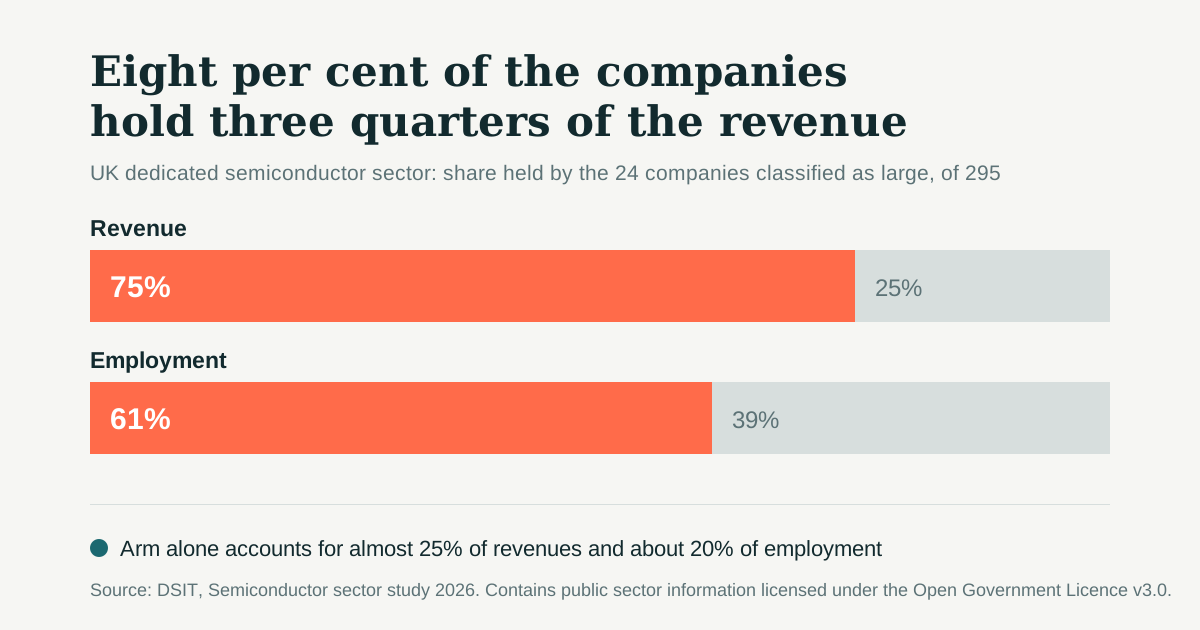
The department's updated sector study, published this month, finds revenue, output and employment all up around 9 per cent, and concentration rising with them. Scale-up capital and energy costs are named as the constraints.
UK angels increasingly invest in groups rather than alone, pooling capital and due diligence through a lead investor. Here's how a syndicate actually operates and how it differs from investing solo.
The Sheffield group's Ocular Integration subsidiary will fit cameras, digital mirrors and video surveillance to 220 new buses, with more than half also connected to Synectics' cloud service.
Public Digital's own 2020 announcement said kyu had taken a minority stake and left the majority in the hands of the founders, and the register shows its three founding shareholders ceased to be persons with significant control that September.
The Department for Science, Innovation and Technology completed publication of its second semiconductor sector study on 2 September, identifying 703 UK semiconductor companies and estimating that dedicated firms generated £10.6bn in revenue and directly employed around 16,350 people in 2025.
A growing list of UK corporates - from insurers to broadcasters - now run their own venture arms alongside traditional VC funds. Here's how corporate venture capital actually differs and what founders should weigh before taking it.
Annual and monthly recurring revenue are the baseline numbers any SaaS scaleup gets judged on, but investors increasingly weigh them against growth efficiency measures like the Rule of 40. Here's what each metric actually means.
Runway is simply how many months a company can keep operating before it runs out of cash, and it is calculated by dividing cash in the bank by burn rate, the amount being spent, net of any revenue, each month.
The UK replaced its separate SME and RDEC R&D tax relief schemes with a single merged scheme from April 2024, alongside a more generous Enhanced R&D Intensive Support regime for loss-making, R&D-heavy small companies, so older explanations of "SME R&D relief" no longer describe how the system works.
A down round is simply a funding round priced at a lower valuation than the company's previous round, and while it is rarely the outcome a founder wanted, it is often a more survivable one than running out of cash entirely.
Each stage of UK startup funding tends to serve a different purpose, attract a different type of investor and expect a different kind of evidence from the company, and knowing the rough shape of the ladder helps you plan more than one round ahead.