DSIT study puts UK semiconductor revenues at £10.6bn, with 24 companies taking three quarters of it
The department's updated sector study, published this month, finds revenue, output and employment all up around 9 per cent, and concentration rising with them. Scale-up capital and energy costs are named as the constraints.
Dedicated UK semiconductor companies generated an estimated £10.6bn in revenue and £7.5bn in gross value added in 2025, and directly employed about 16,350 people, according to the updated sector study published by the Department for Science, Innovation and Technology on 2 September.
Against the baseline study, revenue is up 7 per cent, GVA 9 per cent and employment 9 per cent. The study was commissioned by DSIT and carried out by Perspective Economics.
Growth is real, and it is concentrating
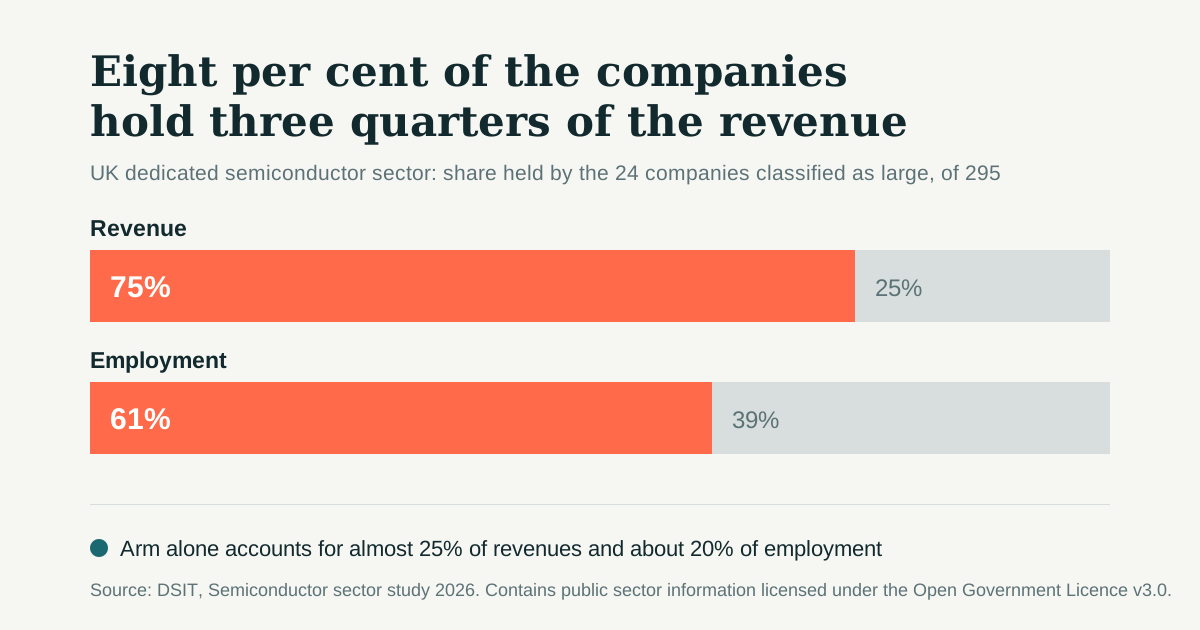
The more striking finding sits underneath the totals. The 24 companies classified as large, which is 8 per cent of the 295 dedicated companies identified, account for an estimated 75 per cent of UK revenues and 61 per cent of employment. The study gives the baseline employment share as 53 per cent, and reports separately that large companies accounted for approximately 66 per cent of revenues in the 2024 study.
Narrowed to the 190 companies present in both datasets, the concentration is sharper still, at 80 per cent of revenues and 66 per cent of employment. The study names Arm as roughly 20 per cent of dedicated company UK employment and close to 25 per cent of revenues on its own.
The pattern repeats in funding. Grants and fundraising across the baseline cohort rose 16 per cent to £1.73bn, with newly identified companies securing a further £400m. Ten companies took 75 per cent of that new grant and fundraising activity: seven design companies, two materials companies and one in manufacturing.
Where the money lands
Of the £400m raised by newly identified companies, 84 per cent went to design-oriented businesses and almost 70 per cent to companies at seed or venture stage, including Fractile and Olix Computing. By registered office, the East of England accounted for 46 per cent, London 26 per cent and the South East 15 per cent.
Public research and innovation funding for semiconductor activity is estimated at £1.8bn by the end of 2025, up from £1.4bn covering 2006 to 2023. Five topics took just under 60 per cent of new allocations between 2024 and 2025: compound materials at 14 per cent, compound semiconductor manufacturing at 12.6 per cent, 3D packaging and integration at 11.8 per cent, photonic integrated circuit design and fabrication at 11 per cent, and memory at 7.4 per cent.
The profile of the sector
Most of the sector is small. Of dedicated companies, 92 per cent are SMEs and 73 per cent are micro or small. Seventy per cent are UK-headquartered, and UK-headquartered firms are markedly smaller than their international counterparts operating here: 81 per cent are micro or small, against 54 per cent of internationally headquartered UK entities.
By activity, 60 per cent of dedicated companies work primarily in research, development, design and IP, 32 per cent in manufacturing, and 8 per cent in materials supply. Revenue per employee runs from £240,000 at micro companies to £675,000 at large ones.
Activity sits in twelve recognised clusters, split between design strength in Cambridge, London, Bristol and Southampton, and manufacturing or materials depth in South Wales, Scotland and the North East. Wales is home to fewer than 10 per cent of dedicated UK-headquartered companies but accounts for 24 per cent of their revenues. The Scottish photonics sector, mostly around Glasgow, turns over more than £1.2bn a year, employs about 6,400 people and exports 97 per cent of its output.
What the sector says is holding it back
Sentiment is strong. Of surveyed firms, 83 per cent expect growth over the next three years and 47 per cent expect rapid growth of more than 20 per cent a year, up from 38 per cent in 2024. Design businesses are the most bullish, at 57 per cent expecting rapid growth against 35 per cent in manufacturing.
The study sets three constraints against that: availability of talent, access to scale-up capital, and UK operating costs, with energy called out specifically. For a sector where the growth is landing disproportionately in a handful of large firms and a cluster of seed-stage design companies in the East of England, the middle of that distribution is where the scale-up capital question bites.