
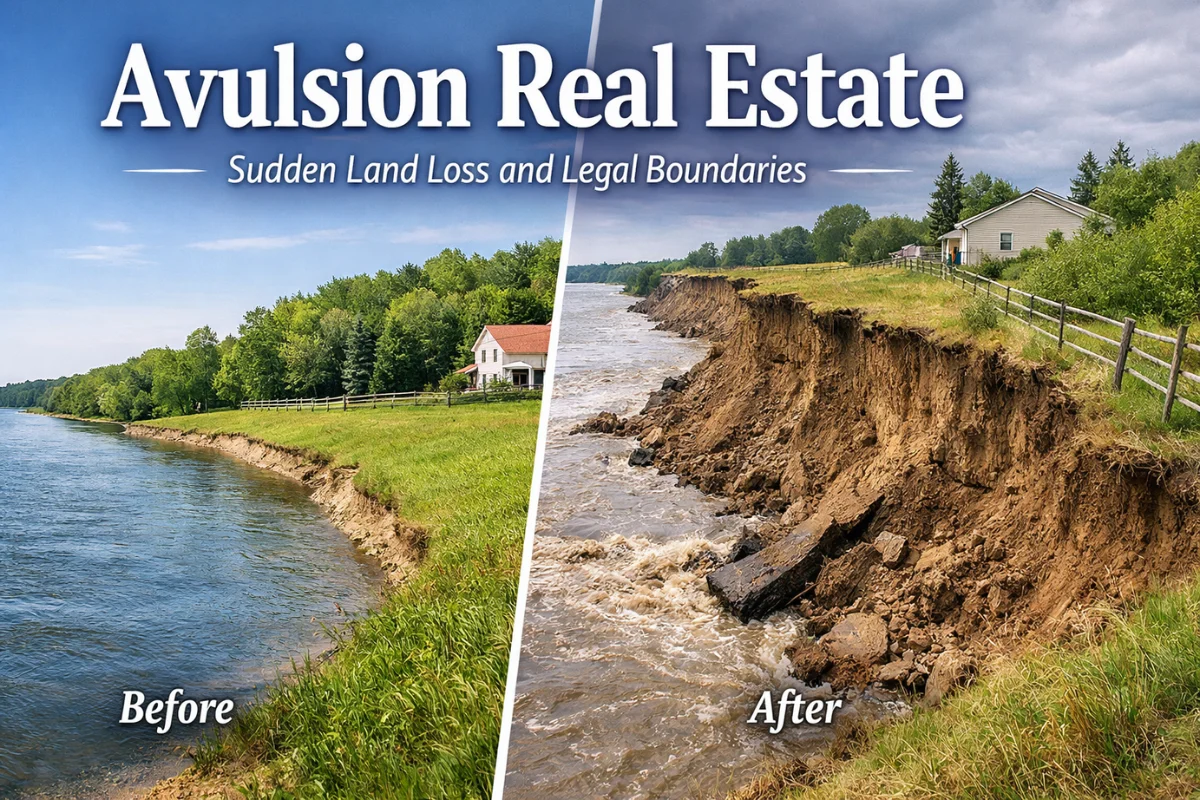
Let’s be honest, when you buy a piece of land, you think of it as, well, solid. It’s your permanent slice of the world, anchored by a survey, recorded in a deed, and bounded by fences or markers. You assume its contours are as fixed as the mountains in the distance. But what happens when those very mountains, or a raging river, or a sudden seismic shift, decides to rewrite the map? In the world of property law, this dramatic event has a name: avulsion real estate.
Unlike the slow, almost imperceptible creep of a riverbank or coastline, avulsion is nature’s sudden edit. It’s the landslide that shears off half your backyard, the flood that whisks away your riverfront, or the earthquake that fractures your parcel. This isn’t a gradual change; it’s a property event. Understanding avulsion in real estate isn’t just academic—it’s crucial for protecting your investment, your legal rights, and your peace of mind if you own land in areas prone to natural forces. This guide will walk you through exactly what avulsion means, why it’s legally distinct from processes like erosion, and the profound implications it can have on ownership, value, and insurance.
Understanding the Legal Definition of Avulsion Real Estate
At its core, avulsion refers to the sudden and perceptible loss or addition of land caused by the action of natural forces. The key words here are sudden and perceptible. This isn’t about a few grains of sand trickling away each day. It’s about a measurable change that happens in an event, often catastrophic.
The legal concept of avulsion real estate serves one primary function: to provide stability and clarity in the chaos that follows a natural disaster. Because the change is rapid, the law typically intervenes to “freeze” property lines as they were documented before the event. This means that even if a chunk of your physical land has been carried downstream, your legal property boundaries often remain where they were originally surveyed.
Think of it this way: the law treats the land as if it were a rug that got torn. The torn piece might be gone, but the blueprint of the rug’s original pattern (your deed) still defines what you own. This stands in stark contrast to other natural processes, which we’ll explore next.
Key Distinctions in Avulsion Real Estate: Erosion and Accretion
This is where property law gets fascinating. The legal outcome of a change to your land depends almost entirely on the speed at which the change occurred. Let’s break down the trio of terms that govern these changes.
Erosion: The Slow Thief
Erosion is the gradual and imperceptible wearing away of soil by wind, water, or ice. Imagine a coastline receding a few inches each year, or a river slowly eating into a bank season after season. Because this process is slow, the law considers the change to be permanent and final. The property boundary moves with the changing contour of the land. If your land slowly erodes into a river, you lose not just the soil, but also the legal title to that portion of your property. The land is simply gone, and your property line is now at the new water’s edge.
Accretion: The Slow Gift
Accretion is erosion’s benevolent opposite. It’s the gradual and imperceptible deposit of soil, sediment, or sand that increases the size of your land. A sandbar builds up over the years on your lakefront, or silt deposits extend your riverbank. Like erosion, because it happens slowly, the law rewards the patience (or luck) of the landowner. The newly formed land generally becomes part of your property, and your boundaries adjust accordingly. This can actually lead to increased property value over time.
Avulsion: The Sudden Shattering
Now, back to our main subject. Avulsion real estate deals with the abrupt. A ferocious spring flood overnight carves a new channel through your field, taking fifty feet of topsoil with it. A hurricane’s storm surge in a single night scours away your beachfront, leaving your home perilously close to the water. An earthquake fault line ruptures, physically displacing a section of land.
The law treats this differently precisely because of its suddenness. It would be unfair and chaotic to immediately reassign property lines every time a disaster strikes. Therefore, the principle of avulsion holds that the original property lines remain intact. You still legally own that lost land, even if it’s now deposited on your neighbor’s property or sitting at the bottom of a river. This creates unique and often complex legal situations, which we’ll delve into shortly.
The table below summarizes these critical distinctions:
Natural Land Changes in Real Estate Law
| Process | Definition | Speed | Legal Effect on Boundaries | Legal Effect on Ownership |
|---|---|---|---|---|
| Erosion | Gradual wearing away of land | Slow, imperceptible | Boundaries move with the land | Lost land is gone; ownership decreases |
| Accretion | Gradual buildup of land | Slow, imperceptible | Boundaries move with the new land | New land is gained; ownership increases |
| Avulsion | Sudden loss or gain of land | Fast, perceptible event | Original boundaries typically remain fixed | Ownership of the original land parcel is retained |
Primary Causes and Examples of Avulsion Real Estate
Avulsion isn’t a random legal term; it’s a direct response to specific, powerful geological and hydrological events. If you own property in an area susceptible to any of the following, the concept of avulsion real estate should be on your radar.
-
Floods and River Course Changes: This is the most classic example. A powerful, sudden flood can cut a new channel (a “cutoff”) for a river, leaving a previously riverfront property high and dry, or it can completely wash away a bank. The 2011 Mississippi River floods, for instance, caused significant avulsive changes to thousands of acres of farmland.
-
Landslides and Mudslides: In hilly or mountainous terrain, saturated ground can give way in an instant, carrying a section of a property downslope. This literally removes the land from its original location.
-
Hurricanes and Storm Surges: Coastal properties are highly vulnerable. The immense power of a storm surge can remove vast amounts of beach, dune, and even underlying soil in a matter of hours, dramatically altering the shoreline.
-
Earthquakes: Seismic activity can cause subsidence (land sinking), uplift (land rising), or lateral spreading. A fault line shifting can physically displace the location of the land itself.
-
Volcanic Activity: While less common, lava flows can instantly destroy land, and volcanic eruptions can deposit new land (like a new island or peninsula) in a sudden event.
The Legal Framework of Avulsion Real Estate
This is the heart of the matter. When avulsion occurs, it sets off a chain of legal questions. The foundational principle—that boundaries remain—sounds simple, but its application is anything but.
The Immovable Boundary Line
In most jurisdictions across the United States, following the principles of common law, the original survey lines documented in your deed are considered sacrosanct after an avulsive event. If Lot 5 was recorded as being 200 feet deep from the road, it remains legally 200 feet deep, even if 50 of those feet are now a 10-foot-deep scoured channel. This can lead to the surreal situation where you legally own a plot of land that is physically underwater or non-existent.
Ownership Rights to the Lost (or Gained) Land
Here’s where it gets even more interesting. Because you retain ownership of the land described in your deed, you may also have rights to that soil or material itself.
-
Lost Land: If a flood tears a chunk of your riverbank and deposits it downstream on your neighbor’s property, you may, in theory, have the right to reclaim that soil. In practice, this is rarely feasible, but the legal right can be a point of contention or negotiation.
-
Gained Land: Conversely, if an avulsive event deposits new land onto your property (for example, a river suddenly changing course and leaving a new gravel bed on your side), the ownership of that new land is less clear-cut and often becomes a matter for courts or specific state statute to decide. It doesn’t automatically become yours in the way accretion does.
The Inevitability of Disputes
Avulsion real estate scenarios are a breeding ground for legal disputes. Neighbors may argue over where the “original” boundary now lies on the altered landscape. A municipality and a homeowner may clash over who owns a newly created shoreline. Insurance companies will scrutinize whether damage was caused by avulsion (often excluded) or by flooding (may be covered). Resolving these disputes almost always requires expert testimony from surveyors, geologists, and attorneys who must pore over historical deeds, surveys, and aerial photographs to establish the pre-event conditions.
Financial Implications in Avulsion Real Estate Cases
Beyond the legal theory, avulsion has very real, often harsh, financial consequences.
Property Value: A Direct Hit
The most obvious impact is on value. A home that has lost a portion of its usable land to a landslide is almost certainly less valuable. A commercial lot whose riverfront access has been replaced by a treacherous erosion scar is less marketable. In rare cases, avulsion could increase value—if a river shifts to create more usable dry land on your property, for instance—but this is the exception, not the rule.
The Insurance Maze in Avulsion Real Estate
This is arguably the most critical practical concern for homeowners. Most standard homeowner’s insurance policies explicitly exclude damage caused by earth movement, including landslides and earthquakes. They also exclude damage from flooding. This creates a perfect storm of coverage gaps.
-
Landslide Avulsion: Typically requires separate earthquake or “difference in conditions” insurance.
-
Flood-Related Avulsion: Requires a separate flood insurance policy through the National Flood Insurance Program (NFIP) or a private carrier.
Crucially, you must understand what your policy covers. The sudden collapse of land (avulsion) is often treated differently from water damage to a structure. You might be covered for the mold in your basement from floodwaters, but not for the fact that your backyard is now in the river.
Navigating Real Estate Transactions
For buyers and sellers, avulsion real estate knowledge is power during due diligence.
-
Buyers: In hazard-prone areas, you must go beyond the standard inspection. Review FEMA flood maps, check for any history of landslides or seismic activity on the property, and ask direct questions about past events. A lender may even require specialized insurance before approving a mortgage.
-
Sellers: Disclosure laws in many states require you to inform potential buyers of any known natural hazards, including past events of avulsion or the high risk of one. Failure to disclose can lead to serious legal liability after the sale.
Insurance Coverage for Avulsion-Related Events
| Event Type | Typical Cause of Avulsion | Covered by Standard Homeowners Policy? | Likely Required Coverage |
|---|---|---|---|
| Landslide | Saturated ground, seismic activity | No (Excluded as “earth movement”) | Separate Earthquake or Landslide Policy |
| Riverbank Collapse | Rapid flooding, undercutting | No (Excluded as “flood” or “earth movement”) | Separate Flood Insurance Policy |
| Coastal Erosion | Hurricane storm surge | No (Excluded as “flood” or “water damage”) | Separate Flood Insurance & Possibly Wind Policy |
| Earthquake Fracture | Seismic shifting | No (Excluded as “earth movement”) | Separate Earthquake Policy |
Risk Management Strategies for Avulsion Real Estate
If you own or are considering purchasing property in a potential avulsion zone, proactive steps are not just wise—they are essential.
-
Conduct Extreme Due Diligence: Don’t just look at the pretty view. Research the property’s history through local planning departments, geological surveys, and even news archives. Use tools like the USGS Landslide Hazards Program maps or FEMA’s Flood Map Service Center.
-
Secure Specialized Insurance: Let the geography guide your policy. If you’re in a flood zone, get flood insurance. In earthquake or landslide country, get that coverage. It’s a non-negotiable cost of ownership.
-
Maintain Impeccable Records: Keep copies of your deed, all historical surveys, and any photographs that document the condition and boundaries of your property over time. This evidence is gold in a dispute.
-
Invest in Mitigation: Consult with geotechnical or civil engineers about preventative measures. These can include retaining walls, improved drainage systems, riprap (rock armor) on slopes or banks, and strategic vegetation planting to stabilize soil. While not foolproof, they can significantly reduce risk.
-
Understand Your State’s Laws: Property law, especially around water rights (riparian rights) and boundary changes, can vary by state. Some states have specific statutes that modify the common law rule of avulsion. A local real estate attorney can provide crucial, location-specific advice.
Case in Point: Real-World Scenarios
-
The Riverfront Farmer: John owned 10 acres bordering a river. A historic, rapid flood cut a new channel, removing 2 acres of his richest soil and depositing it a mile downstream on federal land. Legally, John still owns the title to those 2 acres. He cannot practically use them, and his property’s value is diminished, but for tax and legal purposes, his parcel may still be considered 10 acres. He may also have a complex, likely futile, claim to the soil now on federal land.
-
The Coastal Homeowner: Maria’s beach house was separated from the water by a 100-foot dune. A hurricane’s storm surge completely removed the dune and 70 feet of land, leaving her foundation exposed to the tides. This is an avulsion. Her property line likely still extends to the original shoreline, meaning she now legally owns land that is underwater at high tide. Her structure may be condemned, and her flood insurance will be critical, but her underlying land ownership hasn’t legally changed.
FAQs About Avulsion Real Estate
1. If a flood washes away part of my yard, do I still own that land?
In most cases, yes, you do. The legal concept of avulsion generally means your property boundaries remain as they were described in your original deed and survey. You legally own the land that was lost, even if it’s physically gone. This can affect property taxes and future land use rights.
2. How is avulsion different from my property slowly eroding?
The difference is both physical and legal. Erosion is slow and gradual; the law allows property lines to move with the changing land, and you permanently lose ownership. Avulsion is sudden and dramatic; the law “freezes” the boundaries to prevent immediate and chaotic ownership changes following a disaster. The speed of the event dictates the legal outcome.
3. Will my homeowner’s insurance cover damage from avulsion?
Almost certainly not. Standard homeowner’s policies exclude damage from earth movement (like landslides or earthquakes) and flooding. Since avulsion is typically caused by these events, you would need separate, specific insurance policies such as flood insurance (often from the NFIP) or earthquake/landslide insurance to have coverage.
4. Can avulsion ever increase the value of my property?
It is possible but rare. If a sudden event, like a river changing course, deposits a significant amount of new, usable land on your property or creates a more desirable shoreline, the value could increase. However, the legal ownership of that new land might be disputed, and the destructive nature of avulsive events more often leads to value loss.
5. What is the first thing I should do if I suspect avulsion has affected my property?
Document everything immediately with photos and videos from multiple angles. Then, contact your insurance provider to start a claim, understanding the coverage limitations. Your next critical step is to hire a licensed land surveyor to assess and document the new physical reality against your original deed. Finally, consult with a real estate attorney who specializes in property law or natural disasters to understand your rights and obligations.
Conclusion: Navigating an Unstable Ground
The concept of avulsion real estate is a powerful reminder that the ground beneath our feet is not always as permanent as our legal systems assume. It sits at the uneasy intersection of property law and the raw power of nature. For owners, buyers, and professionals, understanding this distinction isn’t about passing a law exam; it’s about practical risk management. It informs the insurance you buy, the due diligence you perform, and the way you perceive the long-term stability of an investment.
If you own property in a vulnerable area, take this as a cue to review your insurance policies and property records. If you’re considering a purchase, let your curiosity be guided by geology and history, not just aesthetics. The true foundation of secure real estate ownership is built on knowing not just what you own, but the forces that could change it.
Your next step: Pull out your property deed and insurance policy today. Do you know exactly what natural hazards are excluded? If you have questions, schedule a consultation with a real estate attorney or a qualified insurance agent who can help you build a protection plan that accounts for the sudden, dramatic possibilities of avulsion.
Read more: From Infographics to Wix: Modern Web Design Trends for Growing Brands
For more information, Daily Tech Times

As the writer and founder of this blog, I share insights on Tech, Business, Media, Games, Apps, Gadgets, Cybersecurity, Web Development, Podcasts, and Cryptocurrency. My mission is to educate and inspire with engaging, SEO-friendly content that keeps you ahead in the digital landscape.